
Natural convection cooling of a vertical plate involves the transfer of heat from the heated surface to the surrounding fluid (such as air or water) through the motion of the fluid, driven by buoyancy forces. As the plate warms up, the fluid in contact with it becomes less dense and rises, while cooler fluid moves in to replace it, creating a natural circulation or convection current. The efficiency of this heat transfer is influenced by several factors, including the temperature difference between the plate and the fluid, the fluid’s properties, and the size of the plate.
The Grashof number quantifies the relative strength of buoyancy forces to viscous forces, helping to determine the intensity of the convection currents. A higher Grashof number indicates stronger convection and better cooling performance. The Rayleigh number, which combines the effects of buoyancy (Grashof number) and thermal diffusivity, plays an essential role in predicting the onset and strength of convection. The Nusselt number describes the ratio of convective to conductive heat transfer, indicating how effectively heat is carried away from the surface. A higher Nusselt number indicates more efficient convective heat transfer. Finally, the Prandtl number relates the fluid’s momentum diffusivity (how easily the fluid flows) to its thermal diffusivity (how quickly it spreads heat). A high Prandtl number means that heat spreads more slowly compared to the fluid’s motion, while a low Prandtl number means heat spreads quickly. Together, these dimensionless numbers—Grashof, Rayleigh, Nusselt, and Prandtl—help predict the performance of natural convection cooling for a vertical plate.
The formulas used are:
\text{A} = L \cdot \text{W}
T_{film} = \dfrac {[T_{s} + T_{amb}]} {\displaystyle 2}
\beta = \dfrac {1} {T_{film}}
\text{Grashof} = \dfrac{g \cdot \beta \cdot [T_{s} – T_{amb}] \cdot L^3}{\nu^2}
\text{Rayleigh} = \text{Grashof} \cdot \text{Prandtl}
\text{Nusselt} = \left [ 0.825 + \dfrac{0.387 \cdot \text{Rayleigh}^\frac{1}{6}}{\left [ 1 + \left [\dfrac{0.492}{\text{Prandtl}} \right]^\frac{9}{16} \right]^\frac{8}{27}} \right]^2
\text{h} = \dfrac{k}{L} \cdot \text{Nusselt}
\text{Q} = \text{h} \cdot \text{A} \cdot [T_{s} – T_{amb}]
where
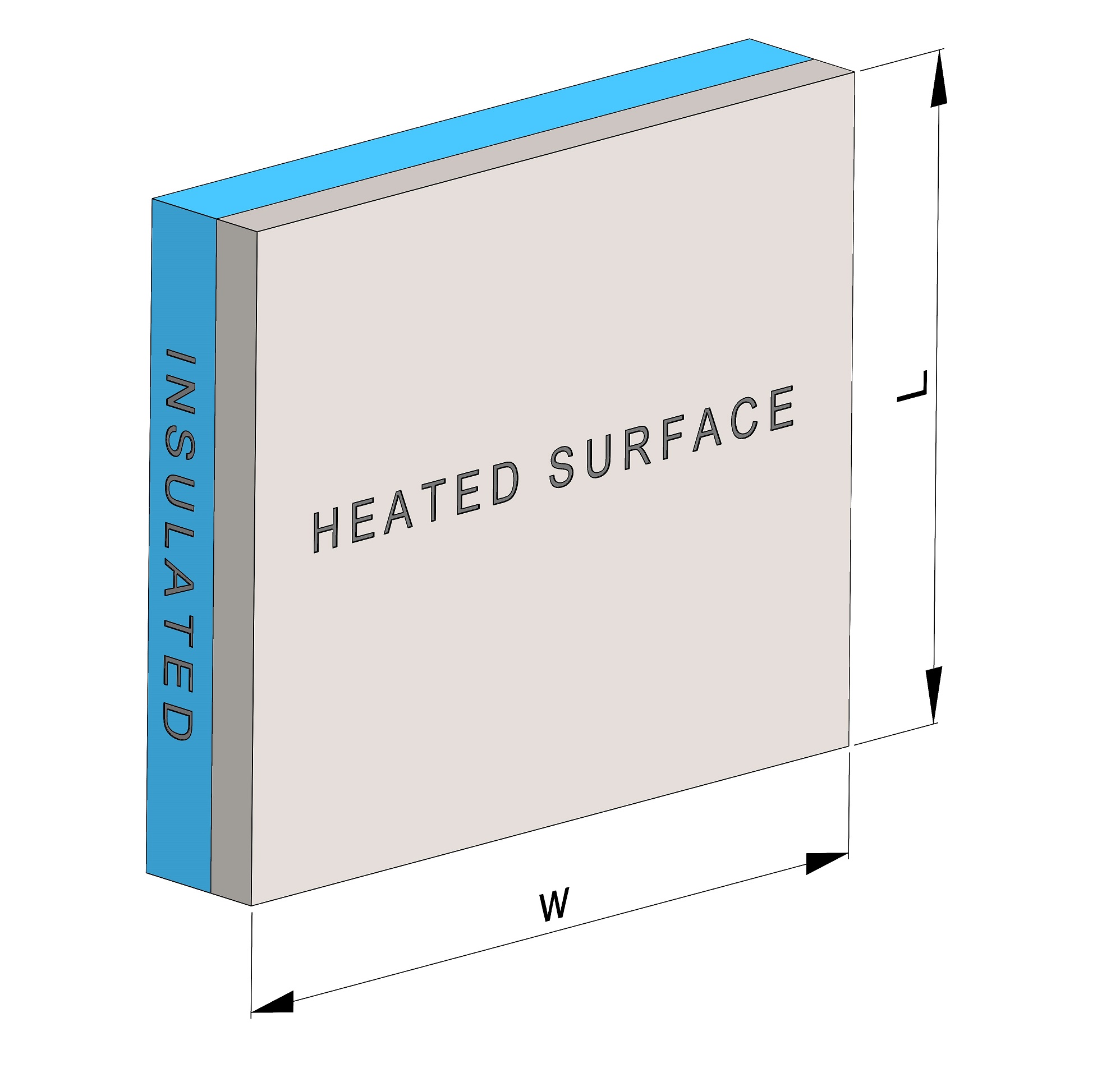
A = surface area of the plate
L = Vertical length of the plate (also known as the characteristic length)
W = Horizontal with of the plate
Tfilm = film temperature
Ts = surface temperature of the plate
Tamb = ambient air temperature
β = volume coefficient of expansion
k = thermal conductivity of the air
ν = kinematic viscosity of the air
h = heat transfer coefficient
Q = natural convection heat transfer
Disclaimer: The information on this page is provided in good faith. Ezee Calc assumes no responsibility or liability for any errors or omissions in the content of this site. Information contained in this site is provided on an “as is” basis with no guarantee of completeness, accuracy or usefulness.