
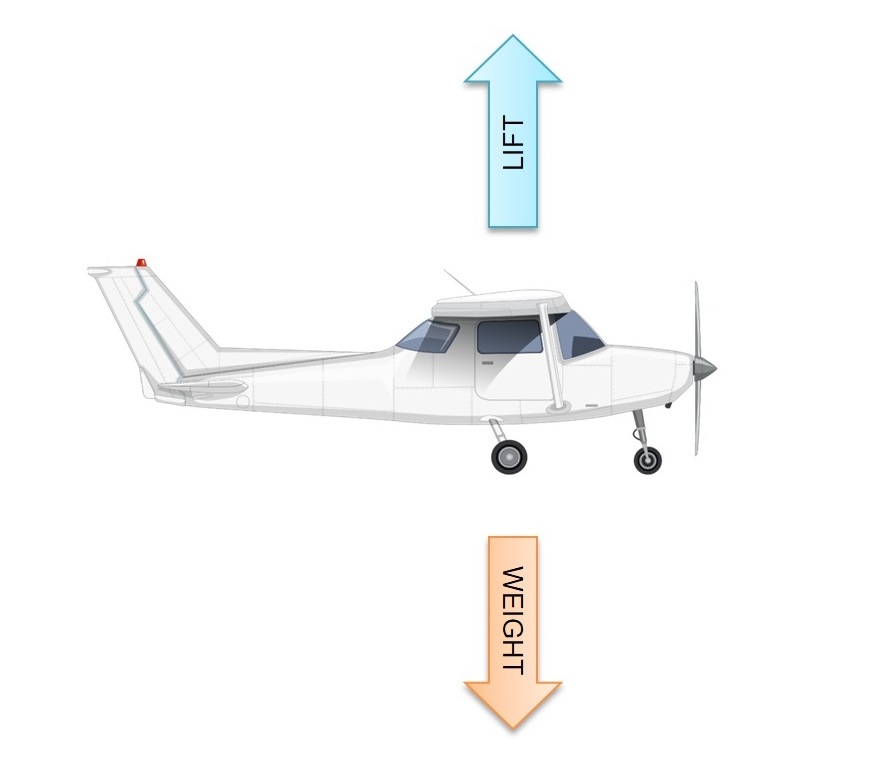
What is lift, and why is it significant? An aircraft’s mass generates a downward force due to gravity, known as weight, which consistently acts towards the center of the Earth. While this force affects all molecules within the aircraft’s structure, we typically consider weight to act through the aircraft’s center of gravity.
Without an opposing force to counteract gravity, an aircraft would be unable to take off. This opposing force is known as lift. Grasping the concept of lift is essential, as it allows the aircraft to ascend and stay in the air. Lift acts through the aircraft’s center of pressure, typically located at the thickest part of the wing. It acts perpendicular to the relative airflow and directly opposes gravity only during straight and level flight. These forces are shown in Figure 1.
To grasp how an aircraft wing generates lift, we can begin with a simple analogy using a flat plate. Imagine extending your flat hand out of a car window while driving. When your hand is held flat and horizontal, you won’t feel any upward or downward force. If you now angle your hand relative to the airflow, an upwards or downward force can be felt that changes with the amount your hand is angled. If you position your hand vertically, you won’t feel lift, but you will notice a significant backward force, known as drag.
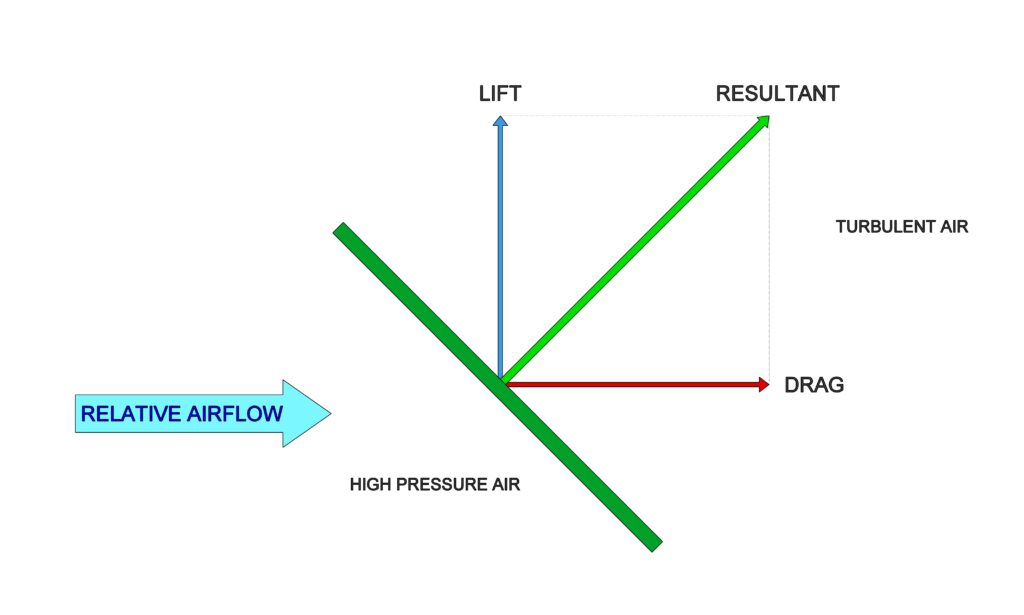
This scenario is illustrated in Figure 2. The airflow strikes the flat plate at an angle, resulting in a force that acts perpendicular to the plate, similar to how the center of pressure acts perpendicular to an aircraft wing. By decomposing this resultant force into vertical and horizontal components, we can identify the lift and drag forces. The front face of the flat plate encounters higher air pressure than the surrounding ambient air, which generates lift. In contrast, the rear side of the flat plate suffers from turbulence, leading to considerable drag, making this type of wing quite inefficient. Keep this concept in mind, as we will revisit it later.
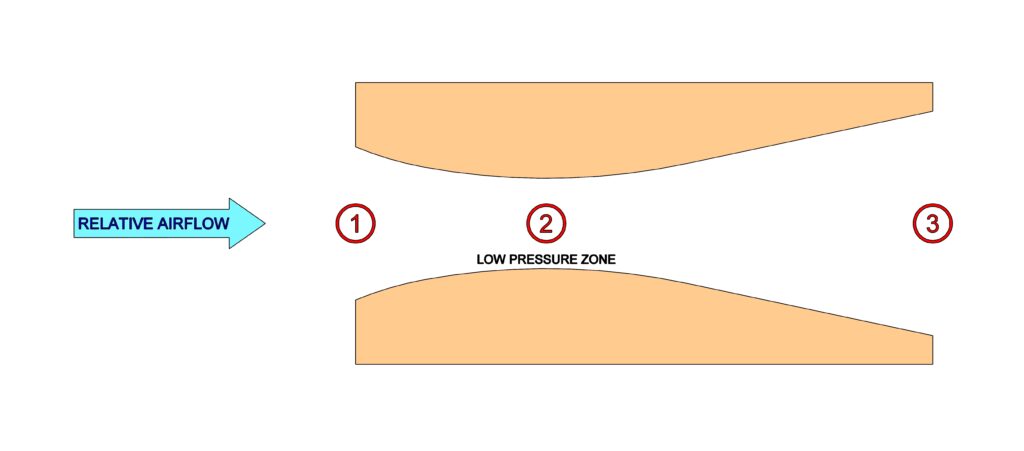
Let’s explore a more efficient method for generating lift through a system known as a venturi, depicted in Figure 3. This design features a wide inlet at point 1 that narrows at point 2 before expanding again at the outlet at point 3.
Albert Einstein famously stated, “Energy cannot be created or destroyed, only transformed from one form to another.” Assuming no losses due to air friction within the duct, the energy at point 1 is equal to the energy at point 2, which is also equal to the energy at point 3.
Bernoulli’s principle breaks this energy down into three components:
Pressure Energy: This is the energy stored in a compressed static fluid. An everyday example is the effort needed to inflate a car tyre with a pump. The loud noise of a tyre blowout is the sudden release of this stored energy.
Kinetic Energy: This refers to the energy an object possesses due to its motion. Consider the feeling of your hand being pushed back when you extend it out of a moving car window; this effect is caused by the kinetic energy of the air.
Potential Energy: This energy is related to an object’s height. For instance, dropping a small stone from one meter won’t cause much damage, but dropping it from a ten-story building will have a far more significant impact due to the increased potential energy from the height.
According to Bernoulli, the total energy (the sum of pressure, kinetic, and potential energy) remains constant within the venturi system. Although the ratios of these energy components may vary at different points in the venturi, the total remains unchanged, consistent with Einstein’s theory. Since the venturi in Figure 3 is horizontal, we can consider the potential energy constant across all points.
Now, let’s examine the flow of air through the venturi. As air enters at point 1, it possesses a certain velocity and pressure. To pass through the constricted area at point 2, the air must accelerate. This is similar to squeezing the end of a garden hose; the water speeds up significantly when restricted.
This increase in speed translates to a rise in kinetic energy, but where does this energy come from? Given that potential energy remains constant in the horizontal venturi, it must come from the pressure energy. At point 2, there is a decrease in pressure energy alongside an increase in kinetic energy, creating a low-pressure zone. As the air moves to point 3, its speed decreases, leading to a reduction in kinetic energy and an increase in pressure energy, completing the energy transformation process within the venturi.
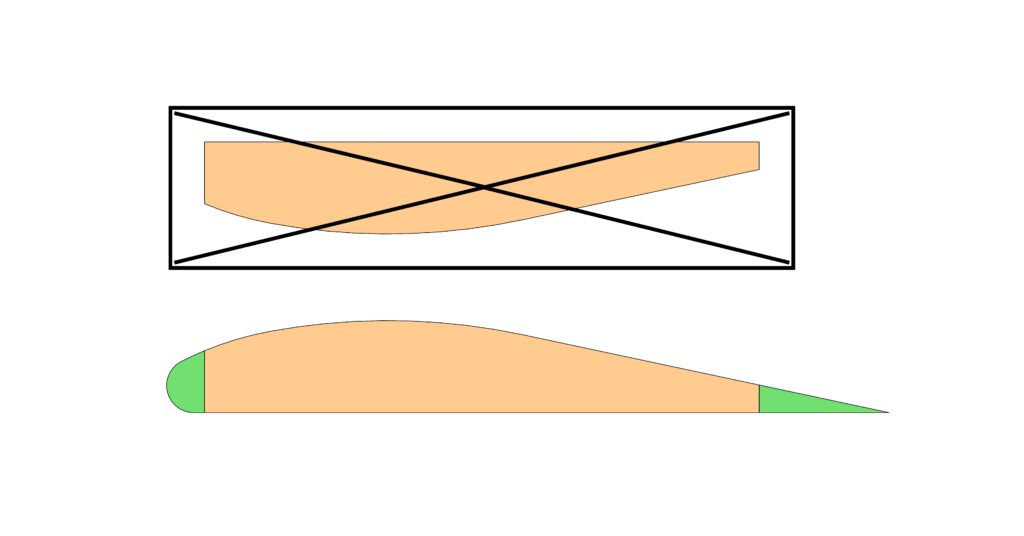
Having explored the dynamics within the venturi, let’s consider a modification by removing the top half of the system, as illustrated in Figure 4. By adding a rounded leading edge at the inlet and a sharp trailing edge at the outlet, we effectively transform our structure into an airfoil (or aerofoil).
Unlike the flat plate that generates lift primarily through high pressure beneath it, the airfoil achieves lift by decreasing the air pressure above it, effectively creating a suction force that pulls the wing upward. This design optimises airflow and enhances lift generation, demonstrating a more efficient approach to the wing aerodynamics.
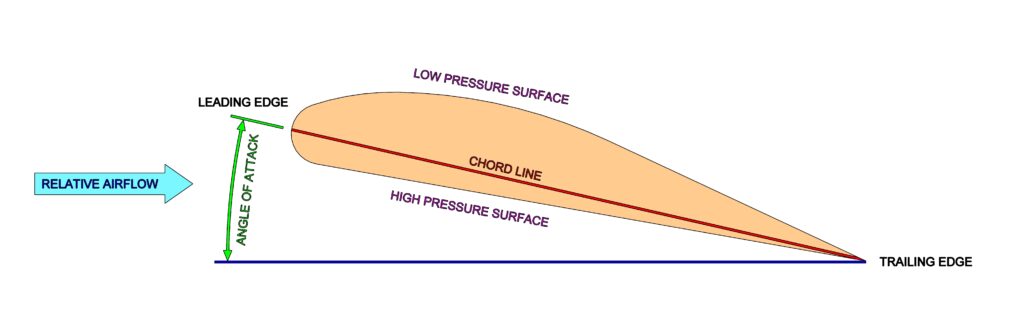
What if we could merge these two principles to generate even greater lift? By slightly angling the airfoil, carefully enough to avoid excessive drag, we can increase the air pressure beneath the wing, effectively pushing it upward. Simultaneously, the air pressure above the wing decreases, creating a suction effect that also lifts the wing. This dual action is precisely how an aircraft wing generates lift.
The angle at which the airfoil is positioned relative to the oncoming airflow is known as the Angle of Attack (AoA). This angle plays a vital role in aviation, making it essential for pilots to understand its implications. Figure 5 illustrates a typical airfoil.
Disclaimer: The information on this page is provided in good faith. Ezee Calc assumes no responsibility or liability for any errors or omissions in the content of this site. Information contained in this site is provided on an “as is” basis with no guarantee of completeness, accuracy or usefulness.